NOT PRINTED —
DRAWN
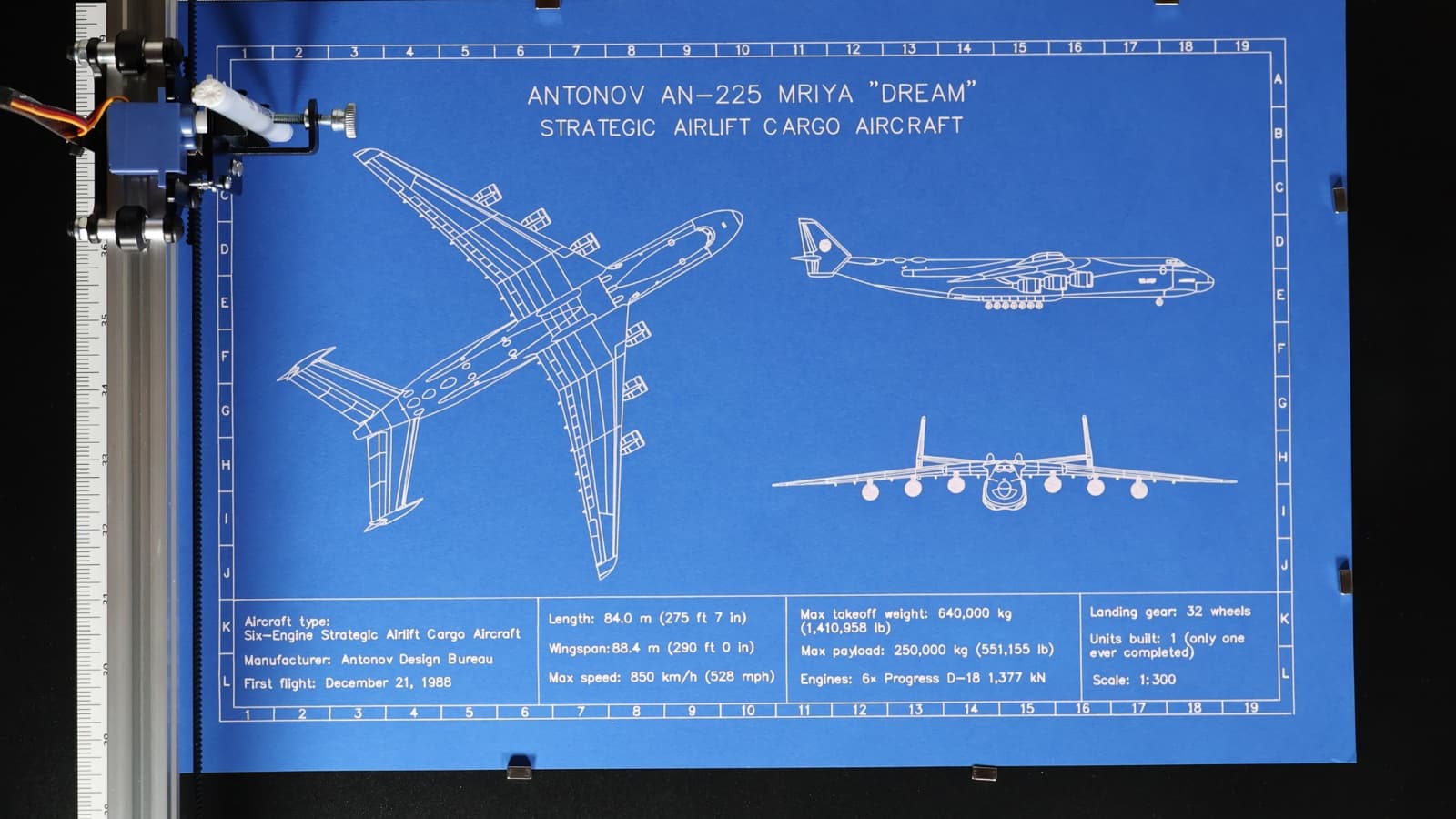
Every line you see was physically deposited by a machine holding a real pen. No pixels. No shortcuts. No Command+P. This is what that looks like.
HOW IT'S MADE
- 01 — Decide
A complete technical drawing holds thousands of lines. Most of them kill the drawing. The work is taking them out — deciding what stays until only what makes the object recognizable is left. No machine does this part.
- 02 — Prepare
Pen, paper, colour, speed, pressure. A pen moving too fast skips; too slow and it bleeds. Every combination is tested on scrap before anything touches the final sheet. The paper is fixed to the bed and squared by hand.
- 03 — Plot
Four to six hours of continuous movement on average, depending on how dense the drawing is. The pen descends, traces, lifts, repositions — hour after hour, without rushing.
- 04 — Sign
The machine stops and a person takes over. Every line checked by hand. On the back, the robot plots a signature invisible to the naked eye in UV ink: the number, the date, the studio. It's laid down in the same pass as the drawing, physically plotted, never printed. Five to seven business days from order to doorstep, anywhere in Canada.
WHAT THE MACHINE
can't do
The plotter holds a real pen and moves with sub-millimetre precision. It plots at about 80 mm per second. It could go faster — it doesn't, because past that the pen skips over the fibre instead of laying ink into it. It doesn't get tired, doesn't rush, doesn't lose focus at hour four. Its hand is steadier than mine will ever be.
It also doesn't choose. It doesn't know which lines matter and which ones kill a drawing. It can't tell when a pen is starting to fail, or when the paper is fighting back.
That part isn't automated. That part is the work.
PERFECTLY
Imperfect
No machine — not even this one — can produce two identical pieces. The slight variation in ink pressure as the pen moves across the paper. The micro-texture where fibre meets metal tip. The way ink pools imperceptibly at the start of each line.
—Ink pressure variation creates subtle differences in line weight — invisible at a distance, visible up close.
—The paper's fibre meets each pass differently — no two strokes are identical.
These are not defects. These are the signatures of a physical process.
“The variation in ink pressure, the texture of fibre meeting metal tip — that's not a flaw. That's the proof it's real.”
READY TO OWN
the result?