
Colour
Layout
Jaguar E-Type Series 1 3.8 (1961) Blueprint Wall Art
Open production · Made after your order
A hand-plotted technical blueprint, drawn stroke by stroke in real ink.
- ✓Made-to-order
- ✓Free shipping — Canada only
- ✓14-day returns
We'll hand your exact text to the operator before plotting — 40 characters max.
Secure checkout via Stripe. Your piece is plotted after you order.
A technical plan of the Jaguar E-Type Series 1 3.8, drawn in pen, line by line, on 250 g/m² paper, 11 × 17 in (27.9 x 43.2 cm). A physical nib presses into the paper and lays down real ink, in Québec. On the back: a serial number and a date, drawn in UV ink in the same pass as the artwork.
The E-Type's silhouette exists as a file, everywhere — a drawing anyone can call up on a screen. What doesn't exist everywhere is a copy that can say who drew it, where, on what day, and under which number.
Unveiled to the press at Geneva in March 1961, the E-Type was designed by Malcolm Sayer — a 2-door fastback coupe built around a 3.8-litre XK inline-six making 265 hp. It ran 0–60 mph in 6.4 seconds and reached 240 km/h, numbers that made it, at launch, one of the fastest production cars in the world for a fraction of the price of anything that could keep pace. Jaguar built 7,670 Series 1 3.8 fixed-head coupes before the model evolved toward its eventual successor, the XJ-S.
At a Glance
- ◆Unveiled to the press, Geneva, March 1961
- ◆Designed by Malcolm Sayer
- ◆3.8L XK inline-six, 265 hp
- ◆0–60 mph in 6.4 s; top speed 240 km/h
- ◆Succeeded by the Jaguar XJ-S
- ◆7,670 Series 1 3.8 FHC built
Each piece is physically plotted by the studio's precision robot in Québec City, using Stabilo® Fineliners and Sakura® Gelly Roll inks on 250 gsm (120 lb) stock — stroke by stroke, never printed. A physical tip presses into the paper and lays down real ink. The result is a tactile, hand-plotted finish — never printed.
Specifications
> FORMAT: Tabloid Standard [11" x 17" / 27.9 × 43.2 cm]
> INK SYSTEM: Stabilo® Fineliner / Sakura® Gelly Roll
> SUBSTRATE: 250gsm High-Density Stock [120lb]
> EXECUTION: Precision Vector Plotting
> PLOT TIME: ~1–1.5 h of machine drawing time
> PRODUCTION: Open · drawn after you order
> ORIGIN: Québec City, Canada
What the robot does, what a person does
The robot
- ◆runs the file
- ◆draws
- ◆lays down ink
- ◆repeats without tiring
A person
- ◆picks the car
- ◆designs the linework
- ◆decides which lines disappear
- ◆sets pressure, speed, pen height
- ◆watches the drawing
- ◆signs, numbers, packs
Drawn by a robot. Designed by a person.
Included
Production timelapse included — every order · no extra cost
Watch your piece being plotted, line by line, by the studio's robot. A personal timelapse of your production is sent with every order — to share, or to keep as a record of how your piece came to be.
Hidden signature
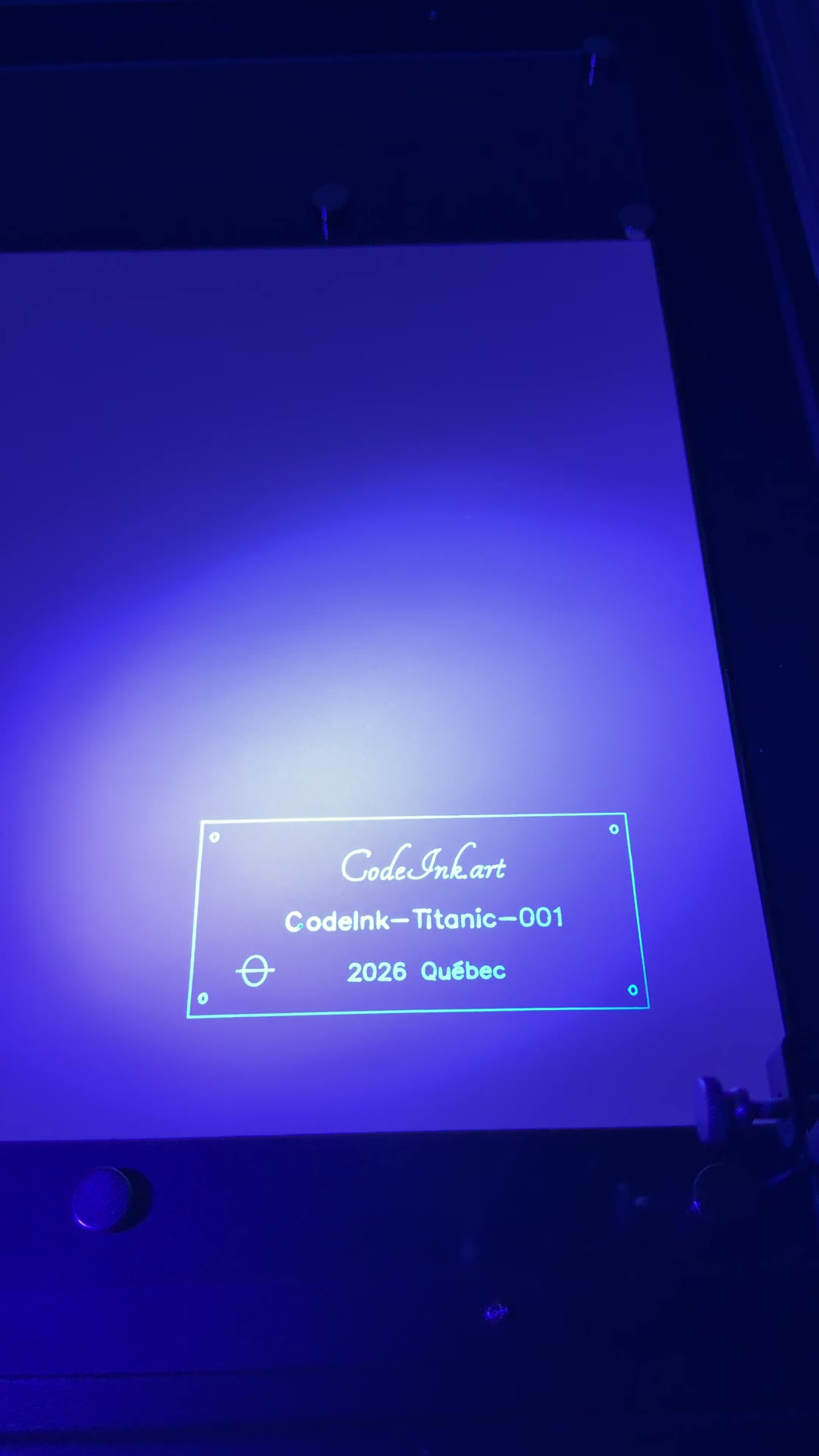
Real footage — an early production piece, shown under blacklight.
A signature only UV light reveals
On the back of every piece, in the same pass as the drawing, we plot a signature invisible under normal light — codeink.art, the piece's name and serial number, the year, and Québec. Shine a blacklight on it and it glows.
“The long bonnet is the whole drawing, really — Sayer came from aircraft design, and it shows in how far the nose runs before you reach the cabin. Getting the curve of the front wings right, the way they tuck down toward the headlamps, took more passes than the rest of the car combined.”
Open production
This piece isn't a limited edition — production stays open. Small variations in ink flow and line closure can occur during physical plotting, giving each plotted piece its own production trace.
The pen wears down as it draws. Ink runs denser at the start. One line closes a hair away from the last. Nothing gets corrected and nothing gets hidden: it's the simplest proof the object was made rather than duplicated.
PERFECTLY imperfect.
A real process, not a printer
Each piece is physically plotted, pen on paper, in Québec City — watch the machine work.
Watch the process14-day returns
Real defects — shipping damage, wrong colour, missing lines — are replaced free of charge.
Read the policySecure checkout
Payments are processed by Stripe. CodeInk.art never sees or stores your card details.
Numbered and signed
A unique serial number and the date are plotted on the back in UV ink — invisible to the naked eye, laid down in the same pass as the drawing.

Want something like this, but yours? Commission a Piece
Questions & Answers
Everything you need to know
> STATUS: RESOLVED
No. This is an independent piece of art — it isn't affiliated with, endorsed by, or sponsored by Jaguar or its rights holders. The car's name is used only to describe the real subject being drawn.
> STATUS: RESOLVED
It is physically drawn. A precision plotting robot holds a real pen and draws every single line on paper — exactly like a human would, but with mechanical consistency. No inkjet. No toner. No digital print.
> STATUS: RESOLVED
Plotting time varies with the size and complexity of each artwork. Every line must be physically drawn across the paper, so more detailed compositions naturally take longer to complete.
> STATUS: RESOLVED
We use real ink applied directly to the paper by the plotter. Ink colours and pen types may vary depending on the artwork. To help preserve the piece, display it away from direct sunlight and excessive humidity.
> STATUS: RESOLVED
No frame is included. We ship unframed intentionally — so you can choose a frame that complements your space perfectly. The piece fits any standard 11" x 17" / 27.9 × 43.2 cm frame available at IKEA, Artifact Uprising, or local framers.
> STATUS: RESOLVED
Every order includes a personal timelapse video of your specific piece being drawn by the robot. It's sent digitally after your piece ships. Perfect for sharing — or for keeping as a record of your piece's creation.
> STATUS: RESOLVED
Yes. We accept commission work for custom blueprints — aircraft, ships, cars, architecture, or any technical subject. Visit our Commission page to start the conversation.
> STATUS: RESOLVED
No. Every drawing starts from a real source — a technical plan, real geographic data, a photo you send me, or code I write myself. What the robot traces is a human decision, not an automatic generation.
> STATUS: RESOLVED
A print sprays droplets onto the surface. Here, a physical tip presses into the paper and leaves a groove of real ink. In raking light you see the line in relief. Under a loupe you see the crushed fibre. It isn't the same object and it doesn't age the same way.
You May Also Like


CodeInk art is not affiliated with, associated with, authorized by, or sponsored by Jaguar or its rights holders. Model designations are used for descriptive purposes only. The trademarks and designations mentioned belong to their respective owners.