
Colour
Layout
Junkers Ju 88 A-4 Pen-plotted blueprint poster, drawn in Québec
Real ink drawn by pen on 250 gsm paper · 11 × 17 in (27.9 × 43.2 cm) · Québec studio
Open production · Made after your order
A plotted technical blueprint, drawn stroke by stroke in real ink.
- ✓Made-to-order
- ✓Free shipping — Canada only
- ✓14-day returns
We'll hand your exact text to the operator before plotting — 40 characters max.
Secure checkout via Stripe. Your piece is plotted after you order.
About the piece
Junkers Ju 88 A-4 the story behind the drawing.
The Junkers Ju 88 first flew December 21, 1936, and went on to become one of the most versatile combat aircraft of the Second World War, adapted over its production run into a bomber, dive bomber, night fighter, torpedo bomber, and reconnaissance platform. The A-4 variant, shown here, was the most-built version, with two Junkers Jumo 211J engines giving it a top speed of 441 km/h (274 mph). Around 15,000 Ju 88s of all types were built between 1936 and 1945, making it one of the most-produced German aircraft of the war — production that, from 1943 onward, relied in part on forced laborers from Buchenwald concentration camp subcamps at Junkers plants including Schönebeck and Halberstadt. This blueprint documents the aircraft as a technical and historical artifact, not a celebration of what it was built to do.
A technical plan of the Junkers Ju 88 A-4, plotted pen to paper, line by line, on 250 g/m² paper, 11 × 17 in (27.9 x 43.2 cm). A physical tip presses into the paper and lays down real ink, one pass at a time. On the back, a serial number and date, plotted in UV ink in the same pass as the drawing.
The plan of the Ju 88 exists as a file, everywhere. What doesn't exist everywhere is a copy someone can point to and say who drew it, where, on what day, and under what serial number.
At a Glance
- ◆66-foot wingspan
- ◆30,865 lb max takeoff weight
- ◆First flew December 21, 1936
- ◆~15,000 built, all variants
- ◆Adapted into 5+ combat roles
- ◆Crew of four
Specifications
- Format
- Tabloid Standard [11" x 17" / 27.9 × 43.2 cm]
- Ink system
- Stabilo® Fineliner / Sakura® Gelly Roll
- Substrate
- 250gsm High-Density Stock [120lb]
- Execution
- Precision Vector Plotting
- Plot time
- ~1–1.5 h of machine drawing time
- Production
- Open · plotted after you order
- Origin
- Québec City, Canada
What you receive
In your box.
Not a poster in a tube. A studio piece, with everything that tells how it was made.
- 01
Your piece, drawn by pen.
Your machine, drawn in real ink on 250 gsm paper, after you order.
11 × 17 in (27.9 × 43.2 cm)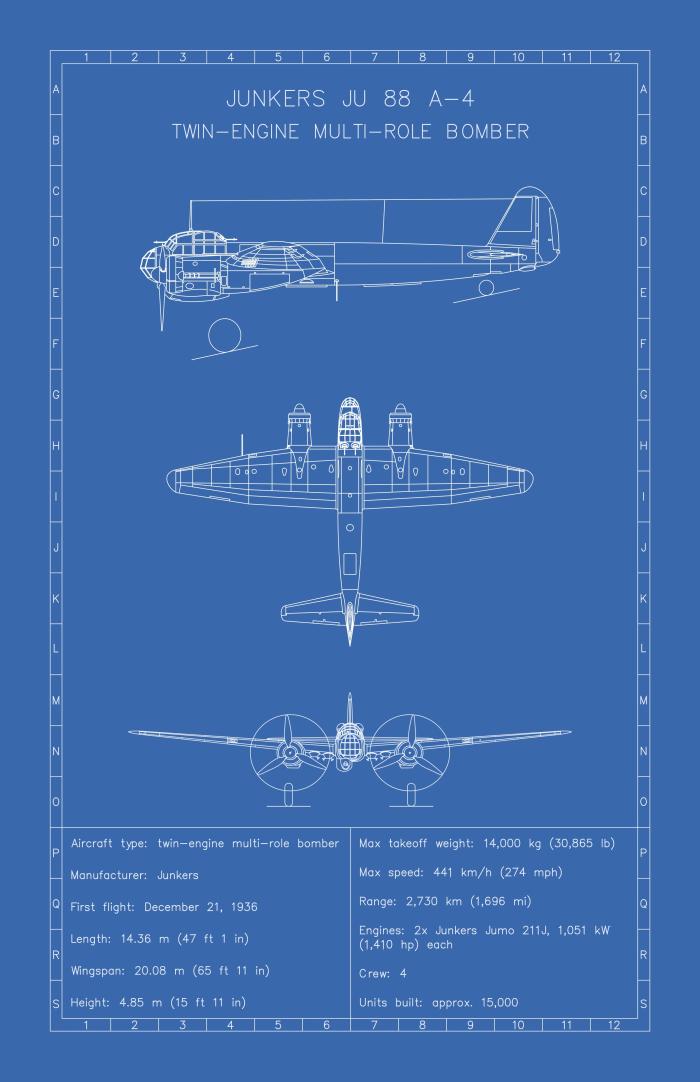
- 02
The film of your piece.
The timelapse of your piece while the pen draws it, from the first line to the last.
Video by email - 03
An invisible signature.
On the back, a unique number drawn in UV ink. It only shows under the lamp, and you get it on video too.
Numbered, UV ink - 04
A note from the studio.
A personalized card with your name, to welcome you to the studio and thank you.
Personalized cardWelcome to the studio - 05
Shipped free.
Made in Québec City, shipped anywhere in Canada at no cost and with no customs tariffs. Damaged in transit? We replace it.
Free shipping in Canada
Questions & Answers
Everything you need to know
> STATUS: RESOLVED
Side profile and plan view, drawn line by line, on one sheet. No livery, no emblem, no registration: technical linework only.
> STATUS: RESOLVED
Proportions and dimensions come from public technical sources, not from an approximate render. If you spot an error, write to us — we correct the file and redraw the piece.
> STATUS: RESOLVED
It is physically drawn. A precision plotting robot holds a real pen and draws every single line on paper — exactly like a human would, but with mechanical consistency. No inkjet. No toner. No digital print.
> STATUS: RESOLVED
Plotting time varies with the size and complexity of each artwork. Every line must be physically drawn across the paper, so more detailed compositions naturally take longer to complete.
> STATUS: RESOLVED
We use real ink applied directly to the paper by the plotter. Ink colours and pen types may vary depending on the artwork. To help preserve the piece, display it away from direct sunlight and excessive humidity.
> STATUS: RESOLVED
No frame is included. We ship unframed intentionally — so you can choose a frame that complements your space perfectly. The piece fits any standard 11" x 17" / 27.9 × 43.2 cm frame available at IKEA, Artifact Uprising, or local framers.
> STATUS: RESOLVED
Every order includes a personal timelapse video of your specific piece being drawn by the robot. It's sent digitally after your piece ships. Perfect for sharing — or for keeping as a record of your piece's creation.
> STATUS: RESOLVED
Yes. We accept commission work for custom blueprints — aircraft, ships, cars, architecture, or any technical subject. Visit our Commission page to start the conversation.
> STATUS: RESOLVED
No. Every drawing starts from a real source — a technical plan, real geographic data, a photo you send me, or code I write myself. What the robot traces is a human decision, not an automatic generation.
> STATUS: RESOLVED
A print sprays droplets onto the surface. Here, a physical tip presses into the paper and leaves a groove of real ink. In raking light you see the line in relief. Under a loupe you see the crushed fibre. It isn't the same object.
You May Also Like


CodeInk art is not affiliated with, associated with, authorized by, or sponsored by Junkers, Airbus (successor to Junkers via Messerschmitt and Messerschmitt-Bölkow-Blohm), or their respective rights holders. Type designations are used for descriptive purposes only. The trademarks and designations mentioned belong to their respective owners.