CodeInk — Cycling Maps
Paris–Roubaix Map Art
Exclusive to CodeInk art · 3D flyover included
A human-designed cycling artwork of the Paris–Roubaix course, from Compiègne to the Roubaix velodrome over the cobbled sectors of northern France, physically plotted with ink on 250 gsm paper in Québec City.
- ✓Physically plotted with ink on 250 gsm paper
- ✓Created to order in Québec City
- ✓Personal production timelapse included
- ✓Made to order in Québec City
- ✓Unframed — fits standard 11 x 17 in frames
- ✓Free shipping — Canada only
- ✓Free replacement if damaged
Compiègne → Roubaix, France. Plotted in real ink, one line at a time, on 250gsm paper.
The course in numbers
Distance
263 km
The course
The Paris–Roubaix course, 263 km from Compiègne to the Roubaix velodrome over the cobbled sectors of northern France — the Hell of the North, a Monument of cycling.
This course leaves Compiègne, about 85 kilometres northeast of Paris and the race's start since 1977, and heads north to Roubaix, on the Belgian border. After about a hundred kilometres it enters the cobbled sectors of the former mining region of northern France, the most famous being the Trouée d'Arenberg, Mons-en-Pévèle and the Carrefour de l'Arbre, the last five-star sector, 15 km from the finish. The race ends with a lap and a half on the concrete of the André-Pétrieux velodrome in Roubaix. The course is almost flat — the highest point is at 163 metres —: here, it's the cobbles that make the selection. This is the exact route plotted here — every turn at its precise intersection.
- Start
- Compiègne
- Finish
- Roubaix Velodrome
- First edition
- 1896
- Nicknames
- Hell of the North · Queen of the Classics
- Winner's trophy
- A cobblestone (since 1977)
The History
Two industrialists and a velodrome, in 1896
Paris–Roubaix was created in 1896 by two Roubaix textile manufacturers, Théodore Vienne and Maurice Perez, who had just opened a velodrome in their town and wanted a big race to finish there from Paris. The first edition was raced on 19 April 1896; it is one of the oldest races in professional cycling.
Why the “Hell of the North”
The nickname doesn't come from the mud or the cobbles, but from the war. In 1919, organizers and journalists drove the route to see what was left after four years of shelling and trench warfare: blackened trees, destroyed villages, mud everywhere. The next day, the papers spoke of “the hell of the north”.
Compiègne, Arenberg and the winner's cobble
The start left Paris for Chantilly in 1966, then settled in Compiègne in 1977 — the year the winner first received a cobblestone as a trophy. The Trouée d'Arenberg, a 2.4 km lane cobbled under Napoleon I and suggested by former miner Jean Stablinski, joined the route in 1968 and became the symbol of the race.
Les Amis de Paris–Roubaix
When the arrival of television pushed towns to pave over their cobbled roads, the organizers founded Les Amis de Paris–Roubaix in 1983 to find, maintain and restore the cobbled sectors. One of them, Alain Bernard, discovered the Carrefour de l'Arbre. The record for wins is four, shared by Roger De Vlaeminck and Tom Boonen.
Why This Ride
Paris–Roubaix is the Hell of the North: dust or mud, the cobbles of Arenberg, the punctures, and that last lap of the velodrome every rider dreams of leading. Here, it's the whole course, Compiègne to Roubaix. Your ride, preserved in ink, one line at a time.
Make the Achievement Yours
Add a name, finish time or short dedication to turn the artwork into a personal record of the work behind the medal. Personalization is optional; leave the field blank for the original composition.
How It Is Made
The composition, hierarchy and final linework are directed by a person. A pen plotter then draws the artwork physically, line by line, with ink on paper. Small production variations can occur during physical plotting.
Plotted by a robot. Designed by a person.
Specifications
> FORMAT: Tabloid Standard [11" x 17" / 27.9 × 43.2 cm]
> INK SYSTEM: Stabilo® Fineliner / Sakura® Gelly Roll
> SUBSTRATE: 250gsm High-Density Stock [120lb]
> EXECUTION: Precision Vector Plotting
What you get
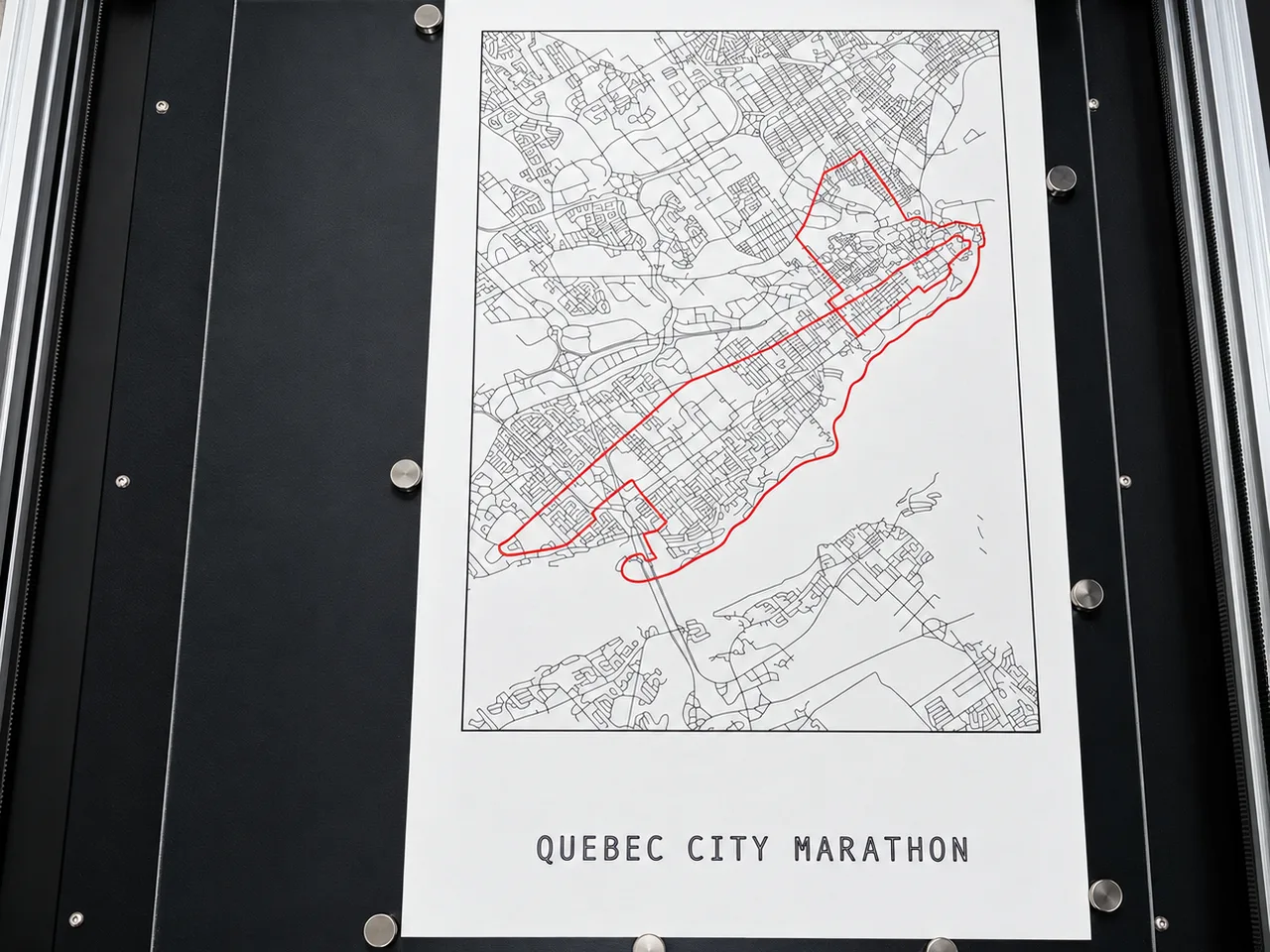
Your piece, plotted in pen
Your name and your time, plotted in ink under the title.
Production timelapse included
The timelapse of your piece being plotted, sent with your order.
Example timelapse — you get the one of your own piece.
A signature only UV light reveals
Serial number, year and Québec City, plotted on the back in UV ink.
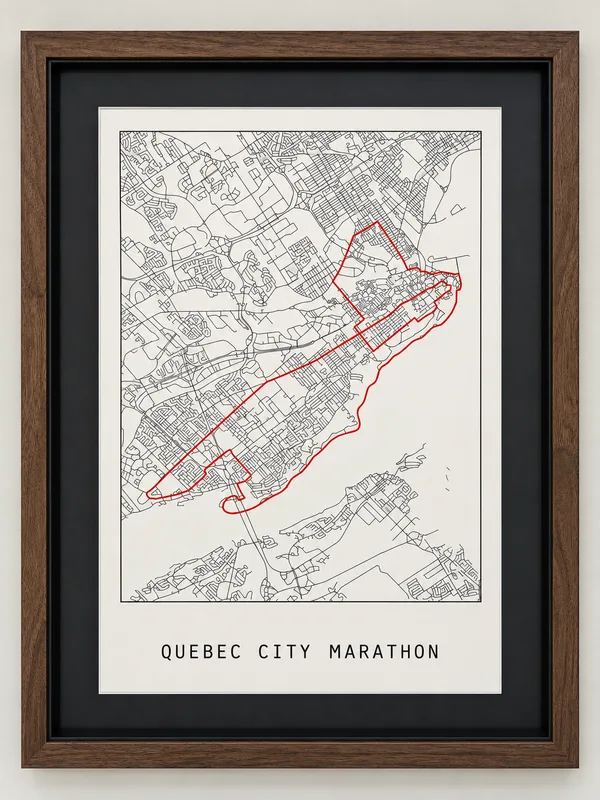
On your wall
Standard 11 × 17 in (27.9 × 43.2 cm): it fits any off-the-shelf frame, so you can pick the one that suits your space.
Frame not included.
A real process, not a printer
Each piece is physically plotted, pen on paper, in Québec City — watch the machine work.
Watch the process14-day returns
Real defects — shipping damage, wrong colour, missing lines — are replaced free of charge.
Read the policySecure checkout
Payments are processed by Stripe. CodeInk.art never sees or stores your card details.
Numbered and signed
A unique serial number and the date are plotted on the back in UV ink — invisible to the naked eye, laid down in the same pass as the drawing.

Independence
Independent artwork inspired by the event named above. CodeInk.art is not affiliated with or endorsed by the organizer.
General questions (size, frame, timelapse…) → The Process
Questions & Answers
Everything you need to know
> STATUS: RESOLVED
The nickname dates from 1919: driving the route after the First World War, organizers and journalists found a landscape devastated by four years of fighting. The papers then spoke of “the hell of the north”.
> STATUS: RESOLVED
More than 50 km of cobbles, spread in sectors over the last 150 kilometres; in 2005, for example, the race had 54.7 km. The route changes a little each year, depending on the state of the roads.
> STATUS: RESOLVED
The three sectors rated five stars: the Trouée d'Arenberg, Mons-en-Pévèle and the Carrefour de l'Arbre, the last of them, about 15 km from the finish.
> STATUS: RESOLVED
Since 1977, the winner of Paris–Roubaix has received a cobblestone as a trophy. The finish is decided on the track of the André-Pétrieux velodrome in Roubaix.
> STATUS: RESOLVED
Since 1977, the start has been in Compiègne, about 85 km northeast of Paris. The race kept its name.
> STATUS: RESOLVED
From one to five stars by difficulty. They are numbered in reverse: sector 1 is the last one, just before the velodrome.
> STATUS: RESOLVED
A straight cobbled road of about 2.3 km through the Raismes-Saint-Amand-Wallers forest, near the old Arenberg mine. On the map, it comes around km 172.
> STATUS: RESOLVED
Roger De Vlaeminck and Tom Boonen, with four wins each.
Don't see your race?
Request your gran fondo, ride or a personal route: we plot any course on request.