
Colour
Layout
Rubik R-26S Góbé Blueprint Wall Art
Open production · Made after your order
A hand-plotted technical blueprint, drawn stroke by stroke in real ink.
- ✓Made-to-order
- ✓Free shipping — Canada only
- ✓14-day returns
We'll hand your exact text to the operator before plotting — 40 characters max.
Secure checkout via Stripe. Your piece is plotted after you order.
A technical plan of the Rubik R-26S Góbé, plotted pen to paper, line by line, on 250 g/m² paper, 11 × 17 in. A physical tip presses into the paper and lays down real ink, one pass at a time. On the back, a serial number and date, plotted in UV ink in the same pass as the drawing.
The plan of the Góbé exists as a file, everywhere. What doesn't exist everywhere is a copy someone can point to and say who drew it, where, on what day, and under what serial number.
Designed by Ernő Rubik Sr. — father of the man who would later invent the Rubik's Cube — the R-26S Góbé first flew as a prototype on May 6, 1961, and went on to become Hungary's standard two-seat training glider. With no engine at all, it depends entirely on shape: a 14-metre wing tuned for a glide ratio of nearly 24 to 1, meaning it can cover almost 24 metres of distance for every metre it sinks. About 195 were built, and many are still flying student pilots today, decades after the type entered service. This blueprint captures a machine with no powerplant to draw — every line on it exists purely to manage air.
At a Glance
- ◆46-foot wingspan
- ◆970 lb max weight
- ◆First flew May 6, 1961
- ◆Designed by the elder Ernő Rubik
- ◆Glide ratio of nearly 24:1
- ◆~195 built, still flying today
Each piece is physically plotted by the studio's precision robot in Québec City, using Stabilo® Fineliners and Sakura® Gelly Roll inks on 250 gsm (120 lb) stock — stroke by stroke, never printed. A physical tip presses into the paper and lays down real ink. The result is a tactile, hand-plotted finish — never printed.
Specifications
> FORMAT: Tabloid Standard [11" x 17"]
> INK SYSTEM: Stabilo® Fineliner / Sakura® Gelly Roll
> SUBSTRATE: 250gsm High-Density Stock [120lb]
> EXECUTION: Precision Vector Plotting
> PLOT TIME: ~1–1.5 h of machine drawing time
> PRODUCTION: Open · plotted after you order
> ORIGIN: Québec City, Canada
What the robot does, what a person does
The robot
- ◆runs the file
- ◆draws
- ◆lays down ink
- ◆repeats without tiring
A person
- ◆picks the aircraft
- ◆designs the linework
- ◆decides which lines disappear
- ◆sets pressure, speed, pen height
- ◆watches the hours
- ◆signs, numbers, packs
Drawn by a robot. Designed by a person.
Included
Production timelapse included — every order · no extra cost
Watch your piece being plotted, line by line, by the studio's robot. A personal timelapse of your production is sent with every order — to share, or to keep as a record of how your piece came to be.
Hidden signature
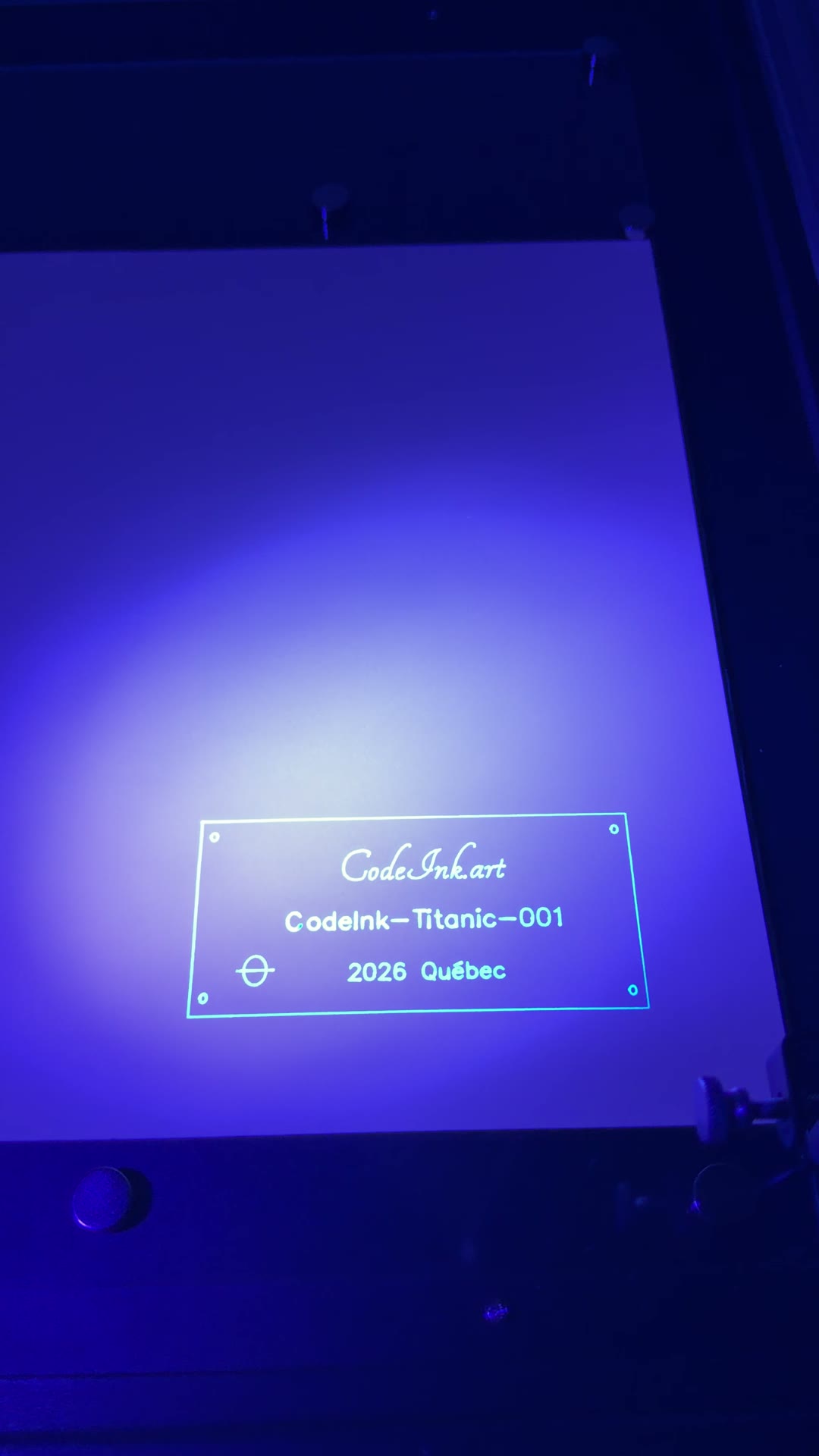
Real footage — an early production piece, shown under blacklight.
A signature only UV light reveals
On the back of every piece, in the same pass as the drawing, we plot a signature invisible under normal light — codeink.art, the piece's name and serial number, the year, and Québec. Shine a blacklight on it and it glows.
“No engine means no exhaust, no intake, no cowling to draw — nothing to hide the aerodynamics behind. A glider's whole design argument is right there on the surface, which makes it one of the purest shapes in this entire catalogue.”
Open production, no duplicates
Every Góbé piece is plotted after you order it — the pen wears down differently each pass, ink density shifts, and no two lines close exactly the same way. Nothing is corrected or hidden.
PERFECTLY imperfect.
A real process, not a printer
Each piece is physically plotted, pen on paper, in Québec City — watch the machine work.
Watch the process14-day returns
Real defects — shipping damage, wrong colour, missing lines — are replaced free of charge.
Read the policySecure checkout
Payments are processed by Stripe. CodeInk.art never sees or stores your card details.
Numbered and signed
A unique serial number and the date are plotted on the back in UV ink — invisible to the naked eye, laid down in the same pass as the drawing.

Want something like this, but yours? Commission a Piece
Questions & Answers
Everything you need to know
You May Also Like


This design depicts a historic 1961 Hungarian training glider produced by a former state manufacturer. No company, trademark, or living rights holder is associated with this specific aircraft design. The trademarks and designations mentioned belong to their respective owners.