
Colour
Layout
Citroën 2CV Economy Car Blueprint Wall Art
Open production · Made after your order
A hand-plotted technical blueprint, drawn stroke by stroke in real ink.
- ✓Made-to-order
- ✓Free shipping — Canada only
- ✓14-day returns
We'll hand your exact text to the operator before plotting — 40 characters max.
Secure checkout via Stripe. Your piece is plotted after you order.
A technical plan of the Citroën 2CV, drawn in pen, line by line, on 250 g/m² paper, 11 x 17 in (27.9 x 43.2 cm). A physical nib presses into the paper and lays down real ink, stroke after stroke.
The 2CV exists as a photo and a spec sheet, everywhere — a drawing anyone can call up on a screen. What doesn't exist everywhere is a copy that can say who traced it, where, and under what serial number.
The Citroën 2CV is a front-engine, front-wheel-drive economy car built by Citroën in France from 1948 to 1990 — more than 3.8 million were made, designed by André Lefèbvre and Flaminio Bertoni, with engineering by Walter Becchia and Marcel Chinon. Conceived before the war as transportation simple and cheap enough for French farmers, it became one of the most recognizable small cars ever built. Power came from an air-cooled flat-twin engine that grew from 375 cc (6.6 kW, 9 hp) in early models to 602 cc (21 kW, 28 hp) in the last, through a 4-speed manual gearbox. Top speed rose over the same span from 65 km/h (40 mph) to 115 km/h (71 mph). At just 600 kg (1,323 lb) curb weight, it measures 3.86 m (152 in) long, 1.48 m (58.3 in) wide, and 1.60 m (63 in) tall, on a 2.40 m (94.5 in) wheelbase.
At a Glance
- ◆3.8 million units built, 1948–1990
- ◆Air-cooled flat-twin, 375–602 cc
- ◆Top speed up to 115 km/h
- ◆Curb weight just 600 kg
- ◆Designed by André Lefèbvre, France
- ◆Built by Citroën, France
Each piece is physically plotted by the studio's precision robot in Québec City, using Stabilo® Fineliners and Sakura® Gelly Roll inks on 250 gsm (120 lb) stock — stroke by stroke, never printed. A physical tip presses into the paper and lays down real ink. The result is a tactile, hand-plotted finish — never printed.
Specifications
> FORMAT: Tabloid Standard [11" x 17"]
> INK SYSTEM: Stabilo® Fineliner / Sakura® Gelly Roll
> SUBSTRATE: 250gsm High-Density Stock [120lb]
> EXECUTION: Precision Vector Plotting
> PRODUCTION: Open · plotted after you order
> ORIGIN: Québec City, Canada
What the robot does. What a person decides.
The robot
- ◆Runs the file
- ◆Draws the body, the wheels, the roof
- ◆Lays down ink, line by line
- ◆Repeats without tiring
A person
- ◆Chooses the car and the view
- ◆Designs which lines survive from thousands
- ◆Sets pen pressure, speed, and height
- ◆Watches the plot from start to finish
- ◆Signs, numbers, and packs the piece
Drawn by a robot. Designed by a person.
Included
Production timelapse included — every order · no extra cost
Watch your piece being plotted, line by line, by the studio's robot. A personal timelapse of your production is sent with every order — to share, or to keep as a record of how your piece came to be.
Hidden signature
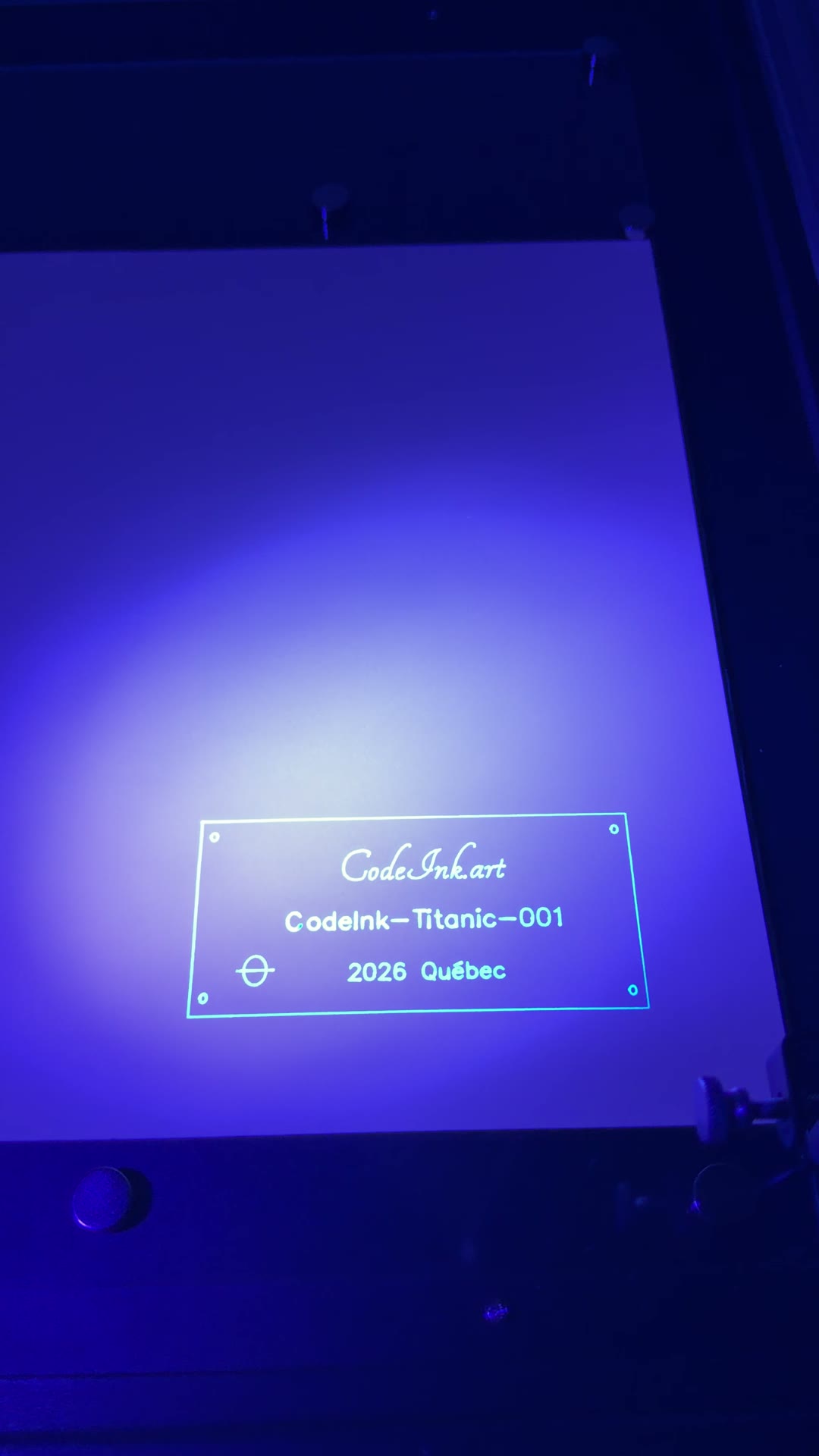
Real footage — an early production piece, shown under blacklight.
A signature only UV light reveals
On the back of every piece, in the same pass as the drawing, we plot a signature invisible under normal light — codeink.art, the piece's name and serial number, the year, and Québec. Shine a blacklight on it and it glows.
“A car this simple was designed on purpose, not by accident — every panel earned its place. Reducing it to a few thousand strokes of ink respects that same restraint.”
Open production, no duplicates
This piece is plotted after you order it — the pen wears down over the hours it takes to draw, so ink density varies slightly and no two lines close exactly the same way. Nothing is corrected or hidden.
There's no cap on how many are made, but each one is drawn individually, signed, and numbered — never a batch, never printed.
A real process, not a printer
Each piece is physically plotted, pen on paper, in Québec City — watch the machine work.
Watch the process14-day returns
Real defects — shipping damage, wrong colour, missing lines — are replaced free of charge.
Read the policySecure checkout
Payments are processed by Stripe. CodeInk.art never sees or stores your card details.
Numbered and signed
A unique serial number and the date are plotted on the back in UV ink — invisible to the naked eye, laid down in the same pass as the drawing.

Want something like this, but yours? Commission a Piece
Questions & Answers
Everything you need to know
You May Also Like


CodeInk art is not affiliated with, associated with, authorized by, or sponsored by Automobiles Citroën or its rights holders. Model designations are used for descriptive purposes only.