
Colour
Layout
Type VIIC U-Boat Blueprint Wall Art
Open production · Made after your order
A hand-plotted technical blueprint, drawn stroke by stroke in real ink.
- ✓Made-to-order
- ✓Free shipping — Canada only
- ✓14-day returns
We'll hand your exact text to the operator before plotting — 40 characters max.
Secure checkout via Stripe. Your piece is plotted after you order.
A technical plan of the Type VIIC U-boat, plotted pen to paper, line by line, on 250 g/m² paper, 11 × 17 in. A physical tip presses into the paper and lays down real ink, one pass at a time. On the back, a serial number and date, plotted in UV ink in the same pass as the drawing.
The plan of the Type VIIC exists as a file, everywhere. What doesn't exist everywhere is a copy someone can point to and say who drew it, where, on what day, and under what serial number.
The Type VIIC was Germany's primary attack submarine of the Second World War, and with 577 built across fifteen shipyards, it remains the most-produced submarine class in history. The first boat, U-93, was commissioned on July 30, 1940. Two diesel engines totaling 3,200 bhp drove it to 17.7 knots on the surface, dropping to two electric motors and 7.6 knots submerged, with a surfaced range of 8,500 nautical miles at cruising speed. Five 53.3cm torpedo tubes — four forward, one aft — carried up to 14 torpedoes, backed by an 8.8cm deck gun through 1943. A crew of 44 to 52 lived inside a pressure hull just over 50 metres long, packed with the diesel plant, batteries, and torpedo stores that this blueprint's cutaway sections lay bare. Type VIICs formed the backbone of the U-boat fleet through the Battle of the Atlantic, and their effectiveness fell sharply after May 1943 as Allied radar, sonar, and air cover closed the mid-ocean gaps they had once operated in freely. This blueprint documents the class as a historical engineering record.
At a Glance
- ◆2x diesel (3,200 bhp) + 2x electric (750 hp)
- ◆17.7 kn surfaced, 7.6 kn submerged
- ◆Range: 8,500 nmi surfaced
- ◆5x 53.3cm torpedo tubes, 14 torpedoes
- ◆Crew of 44–52
- ◆577 built — most-produced submarine class in history
Each piece is physically plotted by the studio's precision robot in Québec City, using Stabilo® Fineliners and Sakura® Gelly Roll inks on 250 gsm (120 lb) stock — stroke by stroke, never printed. A physical tip presses into the paper and lays down real ink. The result is a tactile, hand-plotted finish — never printed.
Specifications
> FORMAT: Tabloid Standard [11" x 17"]
> INK SYSTEM: Stabilo® Fineliner / Sakura® Gelly Roll
> SUBSTRATE: 250gsm High-Density Stock [120lb]
> EXECUTION: Precision Vector Plotting
> PLOT TIME: ~1–1.5 h of machine drawing time
> PRODUCTION: Open · plotted after you order
> ORIGIN: Québec City, Canada
What the robot does, what a person does
The robot
- ◆runs the file
- ◆draws
- ◆lays down ink
- ◆repeats without tiring
A person
- ◆picks the vessel
- ◆designs the linework
- ◆decides which lines disappear
- ◆sets pressure, speed, pen height
- ◆watches the hours
- ◆signs, numbers, packs
Drawn by a robot. Designed by a person.
Included
Production timelapse included — every order · no extra cost
Watch your piece being plotted, line by line, by the studio's robot. A personal timelapse of your production is sent with every order — to share, or to keep as a record of how your piece came to be.
Hidden signature
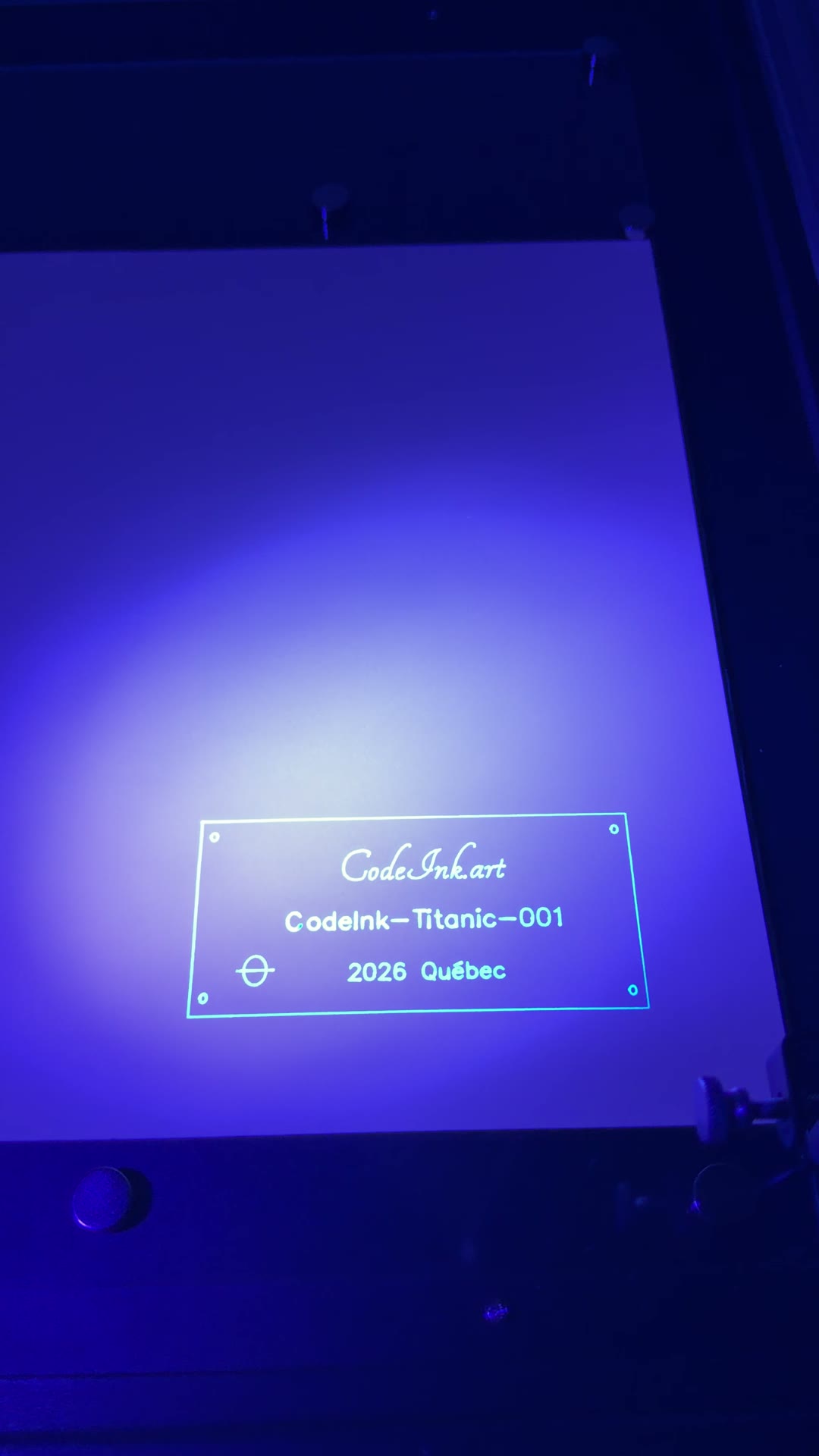
Real footage — an early production piece, shown under blacklight.
A signature only UV light reveals
On the back of every piece, in the same pass as the drawing, we plot a signature invisible under normal light — codeink.art, the piece's name and serial number, the year, and Québec. Shine a blacklight on it and it glows.
“The cutaway sections at the bottom — A, B, C — are the reason this one took longer than most. A submarine's whole design logic is internal: pressure hull, ballast tanks, torpedo racks, batteries, all stacked inside a shape that reveals almost none of it from the outside. Cutting through it was the only way to actually show what the boat was.”
Open production, no duplicates
Every Type VIIC piece is plotted after you order it — the pen wears down differently each pass, ink density shifts, and no two lines close exactly the same way. Nothing is corrected or hidden.
PERFECTLY imperfect.
A real process, not a printer
Each piece is physically plotted, pen on paper, in Québec City — watch the machine work.
Watch the process14-day returns
Real defects — shipping damage, wrong colour, missing lines — are replaced free of charge.
Read the policySecure checkout
Payments are processed by Stripe. CodeInk.art never sees or stores your card details.
Numbered and signed
A unique serial number and the date are plotted on the back in UV ink — invisible to the naked eye, laid down in the same pass as the drawing.

Want something like this, but yours? Commission a Piece
Questions & Answers
Everything you need to know
You May Also Like


This piece is a historical technical illustration of the Type VIIC U-boat class, produced for documentary and educational purposes. It carries no political or ideological association; it depicts a historical vessel class as an engineering record.