
Colour
Layout
Wright Flyer III Blueprint Wall Art
Open production · Made after your order
A hand-plotted technical blueprint, drawn stroke by stroke in real ink.
- ✓Made-to-order
- ✓Free shipping — Canada only
- ✓14-day returns
We'll hand your exact text to the operator before plotting — 40 characters max.
Secure checkout via Stripe. Your piece is plotted after you order.
A technical plan of the Wright Flyer III, plotted pen to paper, line by line, on 250 g/m² paper, 11 × 17 in. A physical tip presses into the paper and lays down real ink, one pass at a time. On the back, a serial number and date, plotted in UV ink in the same pass as the drawing.
The plan of the Flyer III exists as a file, everywhere. What doesn't exist everywhere is a copy someone can point to and say who drew it, where, on what day, and under what serial number.
Built by Wilbur and Orville Wright at their bicycle shop in Dayton, Ohio, the Flyer III first flew on June 23, 1905, and became the aircraft that solved powered flight for good. The 1903 Flyer had proven an engine could get a machine airborne; the 1905 Flyer III proved a pilot could actually control one — banking, turning, circling, and landing safely, again and again, culminating in a 39-minute, 24-mile flight that October. Spruce framing wrapped in muslin, twin pusher propellers on bicycle chains, a 20-horsepower engine the Wrights built themselves. Recognized by ASME as a historic engineering landmark, it's the machine that ended the argument about whether flight was practical. This blueprint captures the canard biplane layout before ailerons, engine cowlings, or a single modern convention had been invented.
At a Glance
- ◆40.5-foot wingspan
- ◆710 lb, fully assembled
- ◆First flew June 23, 1905
- ◆Built by Wilbur and Orville Wright
- ◆First truly controllable airplane
- ◆Flew 24 miles in 39 minutes that fall
Each piece is physically plotted by the studio's precision robot in Québec City, using Stabilo® Fineliners and Sakura® Gelly Roll inks on 250 gsm (120 lb) stock — stroke by stroke, never printed. A physical tip presses into the paper and lays down real ink. The result is a tactile, hand-plotted finish — never printed.
Specifications
> FORMAT: Tabloid Standard [11" x 17"]
> INK SYSTEM: Stabilo® Fineliner / Sakura® Gelly Roll
> SUBSTRATE: 250gsm High-Density Stock [120lb]
> EXECUTION: Precision Vector Plotting
> PLOT TIME: ~1–1.5 h of machine drawing time
> PRODUCTION: Open · plotted after you order
> ORIGIN: Québec City, Canada
What the robot does, what a person does
The robot
- ◆runs the file
- ◆draws
- ◆lays down ink
- ◆repeats without tiring
A person
- ◆picks the aircraft
- ◆designs the linework
- ◆decides which lines disappear
- ◆sets pressure, speed, pen height
- ◆watches the hours
- ◆signs, numbers, packs
Drawn by a robot. Designed by a person.
Included
Production timelapse included — every order · no extra cost
Watch your piece being plotted, line by line, by the studio's robot. A personal timelapse of your production is sent with every order — to share, or to keep as a record of how your piece came to be.
Hidden signature
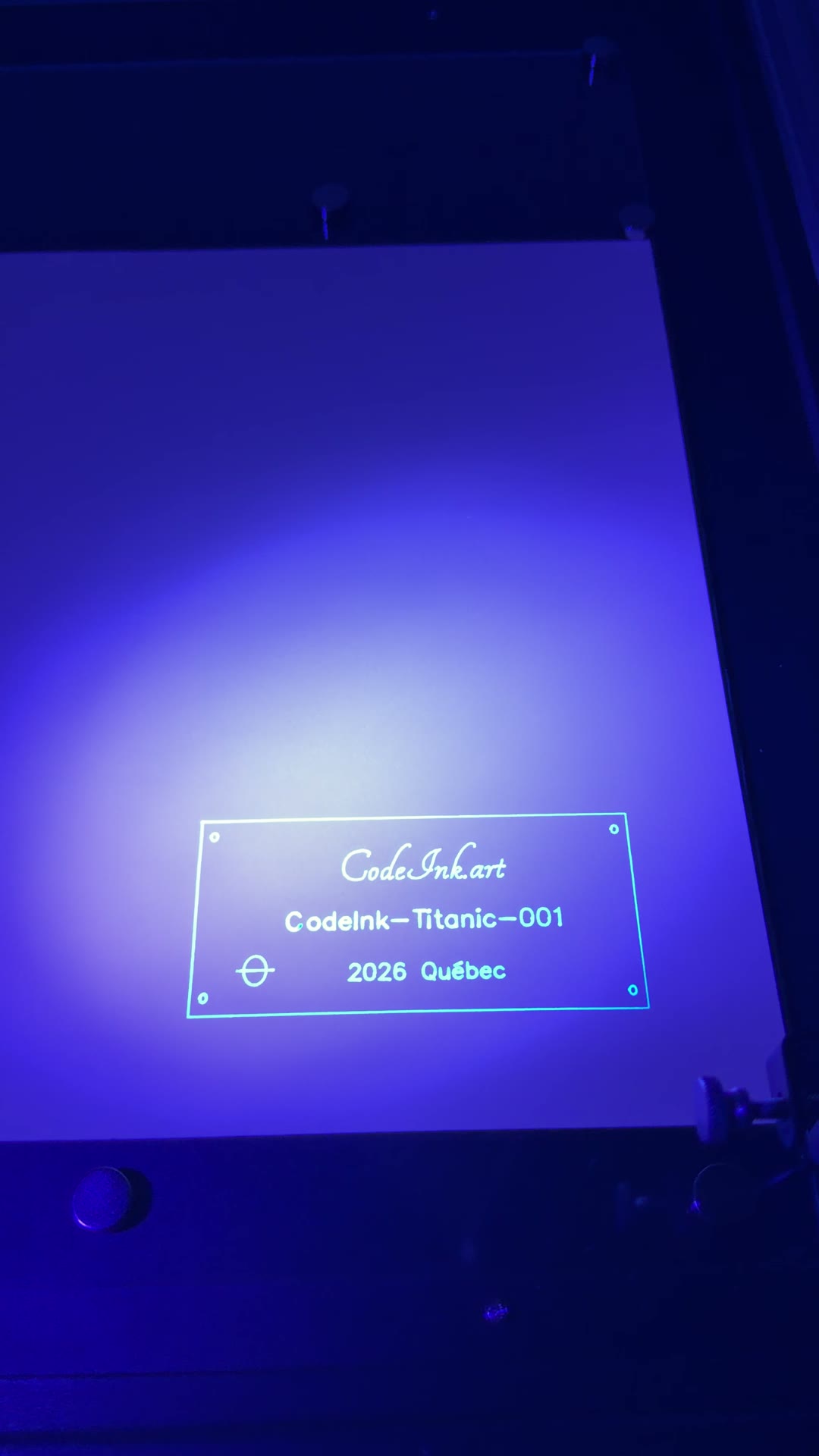
Real footage — an early production piece, shown under blacklight.
A signature only UV light reveals
On the back of every piece, in the same pass as the drawing, we plot a signature invisible under normal light — codeink.art, the piece's name and serial number, the year, and Québec. Shine a blacklight on it and it glows.
“Every other aircraft in this catalogue inherited a century of settled convention — a cockpit here, ailerons there, a tail that always goes in back. This one predates almost all of it. Drawing the bracing wires and open truss structure feels less like technical illustration and more like drawing a bridge that happens to leave the ground.”
Open production, no duplicates
Every Flyer III piece is plotted after you order it — the pen wears down differently each pass, ink density shifts, and no two lines close exactly the same way. Nothing is corrected or hidden.
PERFECTLY imperfect.
A real process, not a printer
Each piece is physically plotted, pen on paper, in Québec City — watch the machine work.
Watch the process14-day returns
Real defects — shipping damage, wrong colour, missing lines — are replaced free of charge.
Read the policySecure checkout
Payments are processed by Stripe. CodeInk.art never sees or stores your card details.
Numbered and signed
A unique serial number and the date are plotted on the back in UV ink — invisible to the naked eye, laid down in the same pass as the drawing.

Want something like this, but yours? Commission a Piece
Questions & Answers
Everything you need to know
You May Also Like


This design depicts a historic 1905 aircraft built by Wilbur and Orville Wright, in the public domain. No company, trademark, or living rights holder is associated with this specific aircraft design. The trademarks and designations mentioned belong to their respective owners.